
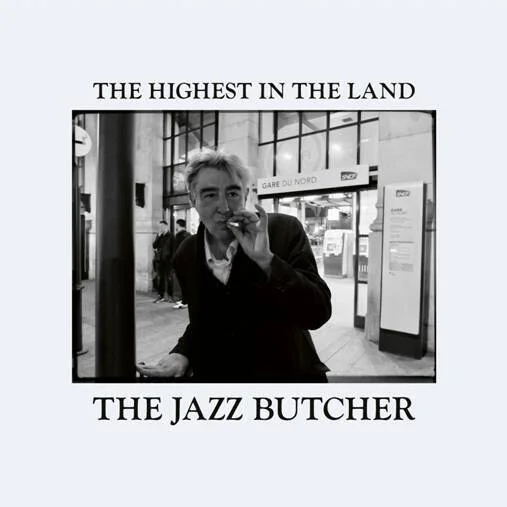
Description
Its not often that an artist gets to do a Bowie by consciously carving their personal epitaph into the grooves of their final LP. The Highest in the Land is that rarity of an album, and it could not have been made by a more brill- iantly poetic and fearlessly sarcastic writer than Pat Fish, also known as The Jazz Butcher.
My hairs all wrong / My time aint long / Fishy go to Heaven, get along, get along, he sings, to a ticking-clock beat in Time, rhyming its title with a one-way ticket to a pit of Council lime in just one of many existentially charged moments on a record whose songs were written throughout the last seven years of Fishs life before his untimely passing in October 2021, aged only 63. Self-knowledge, urgency, he wrote as a comment to this song in his private notes to the albums producer Lee Russell, Hed been around the block. and knew he was on the last had closure, Russell remembers, We had worked together for three months, and then on the last day I drove him home. And for the first time we hugged and said goodbye, and that was it. Recent years have seen a long overdue re-appreciation of The Jazz Butcher catalogue, all the way back to that astonishing 11-album run of the first 13 years of their career, now celebrated and handily compiled in a series of box-sets after decades of shameful neglect.
Founded in Oxford in 1982 by Pat Fish and prodigious guitarist Max Eider, the band that would become synonymous with its leader embodied an anti-rockist, semi-ironically jazz-conscious indie aesthetic before the word had even been invented. In a world of po-faced poseurs this Southern Mark Smith proved that it was possible to be both smart and funny, erudite and unpretentious, the latter sadly to the detriment of his fame.
But, as so often the case, his underratedness only seemed to fuel his sharpness as a writer throughout his later years. It was not for want of material that he allowed a 9-year-gap to open after the penultimate Jazz Butcher album Last of the Gentlemen Adventurers appeared in 2012.
It was a big thing for him that a record company come and ask you to make an album, says Dhiren Basu, Fishs Northampton housemate who became, next to bass player and musical confidante Tim Harries, a sounding board for plans and ideas. That was something that he felt really, really strongly about. As a close friend said, the people he really admired were Lou Reed, Syd Barrett, John Cale and Kevin Ayers, and they were all people who did not bend for anything. There was a sort of ambition to be an English dandy and that uncompromising nature of just saying: This is what Im here to do.
Its no coincidence that a continental label, Hamburgs Tapete Records, should put out The Highest in the Land or that Fish can be seen at the gates of Pariss Eurostar terminal Gare du Nord on the cover shot of the album. Between moving personal songs like Never Give Up or Goodbye Sweetheart and more opaque ones such as the title track (the mysterious Black Raoul, by the way, is Pat and Dhirens cat), much of this album is imbued with righteous ire at the isolationist path taken by the UK in recent times.
Running on Fumes and Sebastians Medication may be the sharpest analyses of the state of Brexit Britain yet committed to song. The gammons are all whining for some kind of reclamation but they dont know what they want to reclaim, Fish fumes in the latter, How the hell are you supposed to leave a continent? Meanwhile, the former stands as an angry state-of-the-nation address, drawing parallels to the Weimar Republic by evoking Hermann Hesse and Mackie Messer, musically cloaked in a Dylan reference suggesting there is indeed blood on the tracks. By contrast, Sea Madness tells the heart-warming tale of an immigrant in tribute to Turkish George, a legendary presence on the Northampton music scene.
Pat was an internationalist, says Dhiren Basu, I think he felt far closer to Europe than his own country. He was always very political, as with most thinking people whove got a sense of justice. He was always going to be an intellectual left-winger. It is not without irony that a career that began in witty defiance of the Thatcher years should end under the shadow of the Johnson era. Certainly, The Highest in the Land sounds as relevant to today as A Scandal in Bohemia did to 1984.
Likewise, in musical terms, it feels like the closing of a circle, based around live recordings by a core band of Fish, Dave Morgan on drums and Tim Harries on bass, augmented by an array of musicians including founder member Max Eider.
While Pat Fishs death may have come suddenly, he had previously been undergoing extensive treatment for cancer, the subject of mortality hanging heavily over the writing process. When recordings began at Lee Russells Dulcitone studios in rural Northamptonshire in June that year, Russell was under the impression that this would be his last record. And it was only when we started making it that I found out he was free of cancer. But he was not delusional. We all go through life acting like its going to last forever, but thats a lie, and Pat was cleverer than the rest of us. He actually was facing it. He was in no mood to compromise his life in any way what- soever, you know, he was sitting at home waiting for his coffee to brew, and he just went. He didnt have to stop smoking or drinking or taking drugs or doing gigs. He missed one live stream, and that was it. He was still Pat Fish. He was still the Jazz Butcher.
Reviews
There are no reviews yet.